The 2026 SaaS UX Maturity Ladder (and Where Most Teams Fall Short)
Most SaaS teams believe they have a UX problem.
But in practice, what they really have is a UX maturity problem — a gap between the complexity of the product and the organization’s ability to design, evolve, and scale it.
After working with 100+ SaaS companies — from early-stage startups to post-Series C growth teams — I’ve found that teams consistently overestimate their UX maturity level.
They aren’t alone.
SaaS products evolve quickly. Teams don’t.
The result is friction, inconsistency, rework, and product debt that quietly compounds.
This framework — The 2026 SaaS UX Maturity Ladder — provides a clear and practical way to diagnose where a product team actually sits, what’s blocking progress, and what’s required to move up the ladder.
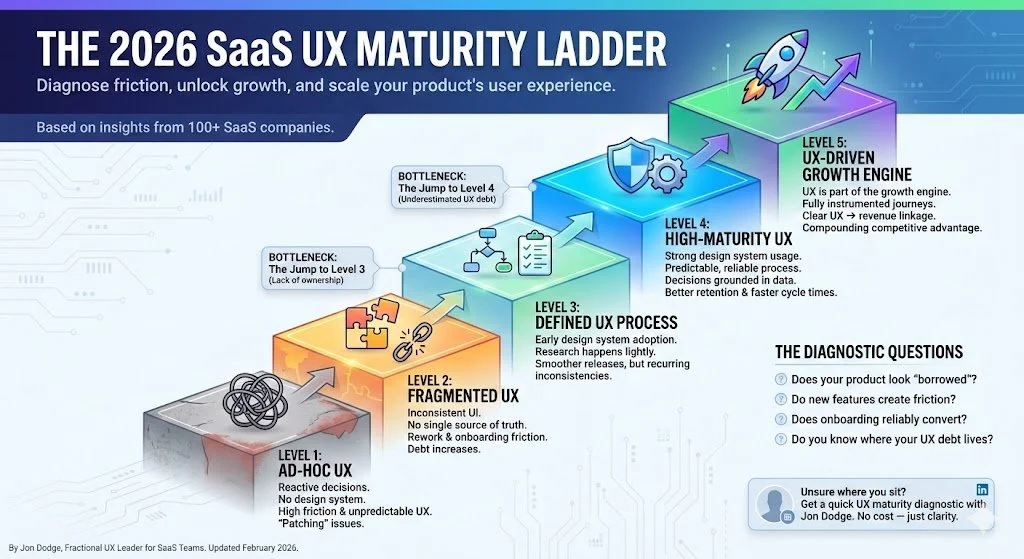
Level 1 — Ad-Hoc UX
At Level 1, product decisions are reactive. Teams design UI on the fly, usually led by engineering or PM instincts rather than a cohesive UX strategy.
Symptoms:
No pattern library or design system
UI varies drastically across screens
Frequent “patching” of UX issues
Support requests spike as complexity grows
What this causes:
High friction, low activation, and unpredictable user experience.
Level 2 — Fragmented UX
This is the most common stage for SaaS products between Seed → Series A.
Some UX structure exists… but it’s not consistently applied.
Symptoms:
Certain flows have been redesigned, others untouched
Different designers or engineers create mismatched UI
No single source of truth
Debt increases faster than improvements
What this causes:
Rework, onboarding friction, and inconsistent product quality.
Level 3 — Defined UX Process
Teams at this stage consciously invest in UX foundations — but usually lack the maturity to scale.
Symptoms:
Early design system adoption
UX involved in planning, but inconsistently
Research happens, but lightly
Collaboration between PM and Design improves
What this causes:
Smoother releases and improved onboarding, but recurring inconsistencies during high-velocity growth.
Level 4 — High-Maturity UX
UX is now a strategic advantage.
Symptoms:
Strong design system usage
Predictable, reliable UX process
Decisions grounded in qualitative + quantitative signals
Cross-functional alignment
What this unlocks:
Better retention, faster cycle times, and more confident roadmap execution.
Level 5 — UX-Driven Growth Engine
At the highest level, UX is not a department — it’s part of the company’s growth engine.
Symptoms:
Fully instrumented journeys
Experimentation culture built into roadmap
Clear UX → revenue linkage
Personalization and optimization driving outcomes
What this unlocks:
Compounding competitive advantage.
Where Teams Get Stuck
Across 100+ SaaS teams, the two biggest bottlenecks I see:
1. The jump from Level 2 → 3
Teams know they need consistency but lack ownership.
2. The jump from Level 3 → 4
Teams underestimate the UX debt they’ve accumulated.
Both transitions require external guidance, maturity modeling, and clarity.
The Diagnostic Questions
Here are the questions I use during UX maturity assessments:
Does your product look “borrowed from multiple teams” over time?
Do PMs and engineering build new features using consistent patterns?
How often do you redesign flows due to unclear requirements?
Do new features create new friction?
Does onboarding reliably convert new users to activation?
Do you know where your UX debt actually lives?
If you hesitate on any of these, you may be operating at a lower UX maturity stage than expected.
Where Does Your Team Sit on the Ladder?
If you’re unsure where your product lands (or want a quick assessment), I’m happy to walk through it with you.
No cost — just clarity.
👉 Get a quick UX maturity diagnostic here: calendly.com/dodgeux/ux-feedback