
We partner with SaaS teams to design intuitive, scalable experiences grounded in real user behavior and product strategy
How We Work
OUR PRINCIPLES
What drives every engagement
Embedded Partnership
We integrate closely with your team, understand your product deeply, and collaborate directly with stakeholders so decisions happen quickly and with clarity. You get hands-on senior support, not layers of project managers or junior designers.
Simplicity in the Complex
We specialize in workflow-heavy and multi-step SaaS products. Our job is to turn complexity into experiences that feel intuitive, predictable, and easy to navigate — even when the underlying system is anything but.
UX Informs Every Decision
We combine behavioral insight, attitudinal research, and industry best practices to guide decisions that support adoption, efficiency, and usability. Every design choice ties back to measurable user and business outcomes.
Clear Expectations
We believe in transparency. You always know what’s coming next, what we’re working on, and how decisions were made. No surprises. No ambiguity. No noise.
OUR PROCESS
A flexible, repeatable framework for clarity and momentum
Our process adapts to the complexity of your product, its maturity, and your team’s needs. It creates structure where teams often feel ambiguity - without slowing down iteration or creativity.
1 | Discovery of your needs
We begin by understanding your product at its core. Through stakeholder interviews, product walkthroughs, system mapping, and UX audits, we reveal:
workflow friction
unclear paths
misaligned expectations
usability blockers
gaps between business goals and user needs
This step builds a shared baseline of truth and establishes the foundation for decision-making.
2 | Generative Research
Before designing anything, we uncover how users think, behave, and make decisions.
We use a combination of:
user interviews
task-flow reviews
heuristic evaluations
competitive analysis
journey mapping
These methods help us understand motivations, frustrations, expectations, and mental models, the raw ingredients of strong UX strategy.
3 | Concept Development & Insight Analysis

This is where research turns into clarity.
We synthesize insights into frameworks and align your team around what problem to solve and why.
This may include:
opportunity areas
concept models
early sketches or system logic
revised workflows
new structural patterns
This step ensures we are solving the right problem, not just the visible one.
4 | UX/UI Design & Prototyping
Once alignment is in place, we translate insight into intuitive product experiences.
We design:
workflows
logic paths
user journeys
interface components
responsive layouts
interaction patterns
Then we prototype to validate direction, gain stakeholder buy-in, and expose any usability friction before engineering begins.
The methodologies we use to uncover meaningful product improvements
DESIGN APPROACHES

We draw from a blend of generative, evaluative, and systems thinking methodologies. Each one answers a different question about your product and user behavior.
We use design approaches to determine:
what users are trying to accomplish
why certain tasks feel difficult
where workflows break down
how decisions happen in the real world
what patterns support clarity and predictability
how the experience can scale
Methods we commonly apply:
Heuristic analysis to evaluate existing usability
Task-flow modeling to reduce friction in multi-step processes
Decision logic mapping for complex branching paths
Journey mapping for emotional and functional insight
Concept modeling to align teams early
Prototyping to validate assumptions before development
These methods help teams avoid costly rework, find clarity faster, and build with confidence.
Understanding how people think, feel, and act
RESEARCH METHODS

Strong UX requires understanding both what users say and what they actually do.
We combine attitudinal and behavioral research because each uncovers different layers of truth.
Behavioral Research
Reveals real patterns in how people:
complete tasks
navigate a workflow
handle errors
form mental models
adapt to system constraints
This tells us how the product supports or hinders real action.
Attitudinal Research
Reveals how people:
perceive value
feel about friction
describe challenges
evaluate success
define expectations
This helps us design experiences that align with their motivations and decision-making.
Common methods we use:
contextual inquiry
observational studies
moderated testing
unmoderated prototype reviews
concept testing
surveys + attitudinal validation
Together, these approaches help us build products that feel natural, reduce cognitive load, and support the way people actually work.
Built for clarity, speed, and real-world product teams
WHY IT WORKS
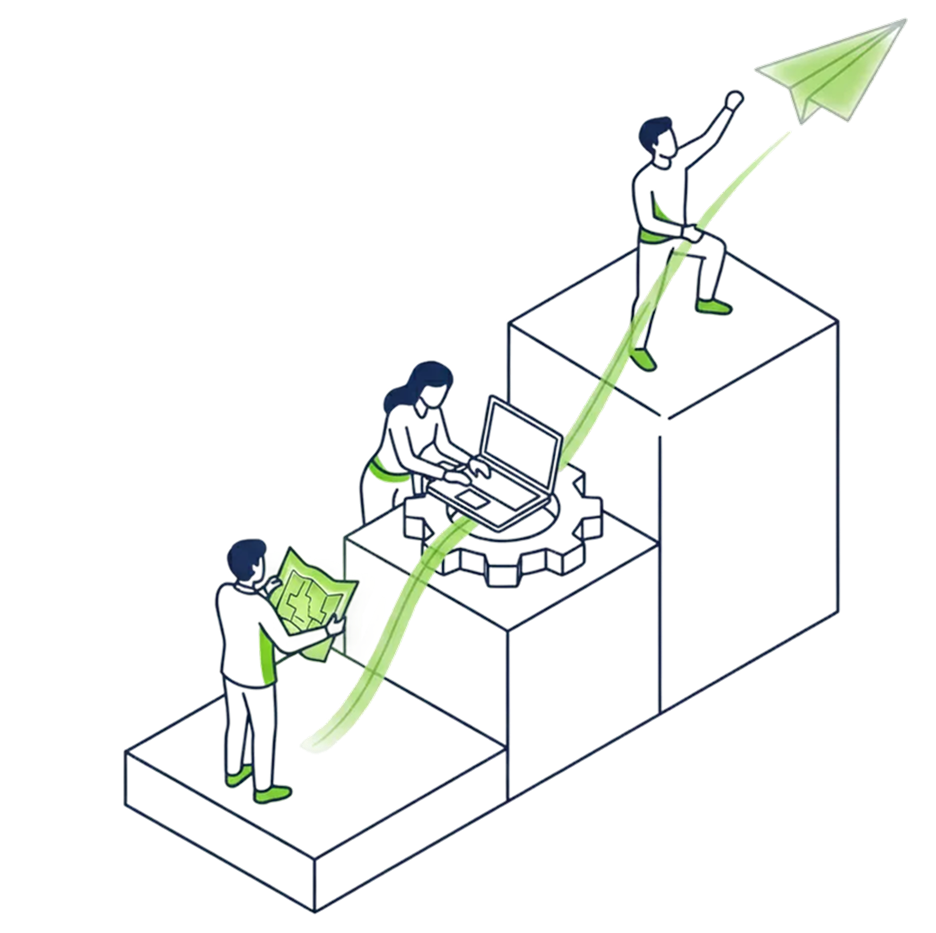
SaaS teams move quickly - and UX should support that momentum, not slow it down.
Our approach is intentionally flexible, collaborative, and built for complex product ecosystems.
It works because it:
aligns stakeholders early
reduces unnecessary iteration
exposes problems before engineering
creates shared understanding across teams
scales from MVP to enterprise
blends strategy with hands-on senior execution
The result is software that feels intuitive, behaves predictably, and supports users without forcing them to think.

Ready to improve your SaaS product?

Speak directly with Jon Dodge, Founder of DodgeUX, about your product, your users, and the challenges you’re facing.
Get clarity on what’s holding your experience back, and how stronger UX can move your product forward.
FAQ
-
What are your project delivery costs and timelines?
Costs and timelines vary depending on the product’s complexity, the number of workflows, and how much strategy and research are required up front.Before any engagement, we run a focused Scope Definition to map the effort, sequencing, and delivery milestones. That gives you a clear, fixed estimate for design work before we begin.
Most SaaS teams come to us because they want predictable delivery, senior execution, and no surprises—so we structure every project with transparent phases, weekly checkpoints, and clear decision points.
If you’d like rough ranges or want to walk through your product, feel free to book a consultation and we’ll talk through options.
-
How do you ensure the design aligns with our business goals?
Every engagement starts with clarity: your revenue model, your activation funnel, the jobs-to-be-done, and where friction is slowing growth.We translate your business goals into measurable UX objectives, then validate decisions through research, rapid prototyping, and stakeholder working sessions.
Our role isn’t just to design screens — we design outcomes: higher adoption, reduced support burden, faster workflows, and clearer decision paths for your users.
-
How do you handle user feedback and iterations?
We work in fast, structured design cycles so teams can see progress weekly.Depending on the engagement, we run:
User interviews & usability tests
Prototype validation
Feedback-driven iteration loops
Design reviews with product + engineering
This ensures decisions are grounded in real user behavior, not internal assumptions — and that we can confidently hand off designs that are ready for engineering without churn.
-
How do you ensure the design is scalable and maintainable?
SaaS products evolve fast, so we build with scalability in mind from day one.This includes:
Modular, reusable component architecture
Robust design system foundations
Clear documentation that supports engineering
Patterns that scale across new roles, use cases, and feature areas
Your product should grow without redesigning the house every time — our design approach guarantees long-term maintainability and drastically reduces future design debt.
-
Do you replace an internal design team or support them?
We do both. Many SaaS companies bring us in as a senior extension of their team, offering leadership, clarity, speed, and system thinking that accelerates progress and complements internal designers.Others rely on us as their primary product design partner until a full internal team is ready.
-
How quickly can you begin?
Most projects can begin within 1–2 weeks following a Scope Definition call.For urgent engagements, we offer accelerated onboarding when capacity allows.
-
What industries or SaaS products do you specialize in?
We’ve designed over 70+ SaaS products across AI, healthcare, fintech, marketplaces, logistics, and complex enterprise workflows.Our strength is untangling complexity — multi-portal systems, deep data models, and products where clarity and usability directly impact revenue.
-
Do you offer UX audits before full projects?
Yes. Many teams start with a UX Audit + Improvement Plan, which includes friction analysis, workflow evaluation, heuristic scoring, and actionable design recommendations.This is a fast way to get clarity without committing to a full redesign.
-
How do you collaborate with engineering?
We design with buildability in mind.We involve engineering early, align on constraints, and deliver clear documentation, responsive specs, and production-ready assets — ensuring design handoff is smooth and efficient.
-
Do you work with early-stage and established SaaS companies?
Yes. We support teams from seed-stage MVPs to enterprise-grade platforms with thousands of users.Our process adapts to your maturity and goals.